
Since January 1, 2026, Amazon no longer preps or labels inventory for US FBA. Every unit has to arrive ready to sell: a scannable FNSKU label (or an eligible manufacturer barcode), poly bags at least 1.5 mil thick with a suffocation warning when the opening is 5 inches or more, a double seal on liquids over 4.2 oz, bubble wrap or a box on anything that cannot survive a 3-foot drop, sets sealed and labeled, and boxes no larger than 36 x 25 x 25 inches or heavier than 50 lb. Amazon can refuse, return or dispose of unprepped units at your cost, and it will not reimburse them if they are damaged.
Key takeaways
- Amazon stopped prepping and labeling US FBA inventory on January 1, 2026, including inventory sent through AWD, AGL, Amazon SEND and Supply Chain Portal.
- There is no paid prep service to fall back on. Unprepped units can be refused, returned, repackaged or disposed of at your cost, and they lose reimbursement.
- Since March 31, 2026, resellers need an FNSKU on every unit. Brand owners can stay stickerless only if the product has a manufacturer barcode.
- The standard box limit is now 36 x 25 x 25 inches and 50 lb. Many guides still quote the old 25-inch limit.
- Most rejections come from six checks: barcodes, poly bags, liquids, fragile items, sets and cartons.
- Run the checklist below on every shipment, wherever the prep happens: in-house, at the factory or at a prep center.
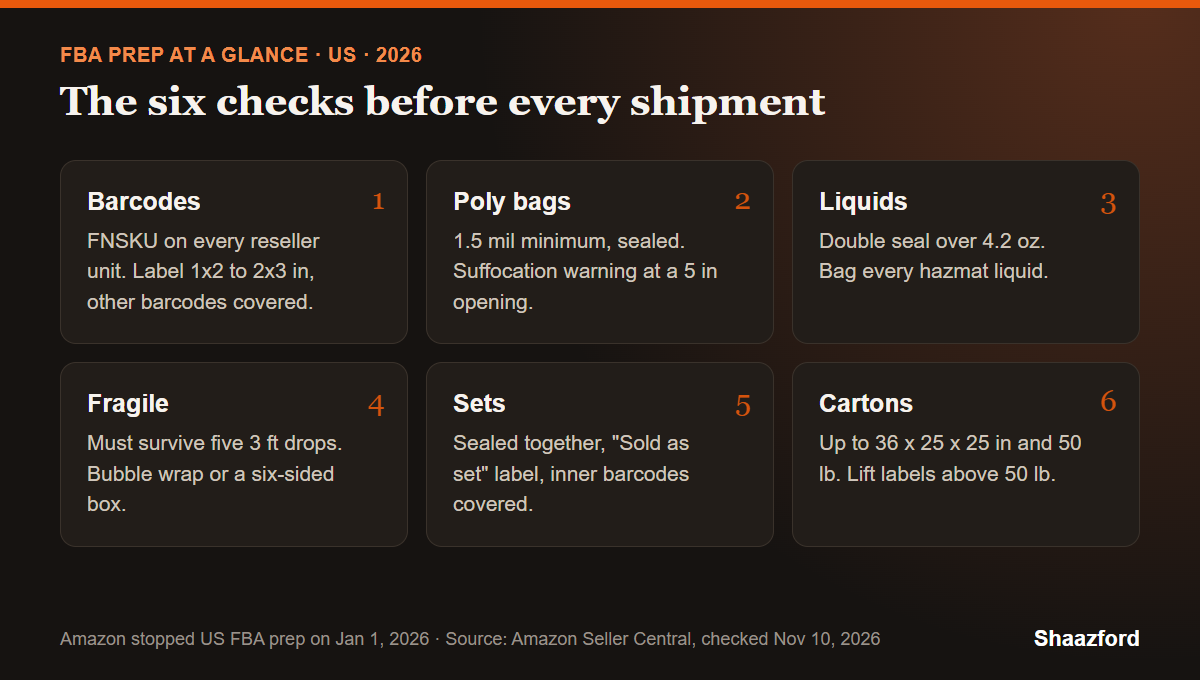
What changed for FBA prep on January 1, 2026?
Until the end of 2025, a US seller could send unprepped or unlabeled units and let Amazon do the work for a per-unit fee. That service is gone. Amazon announced in summer 2025 that it would stop prep and item labeling for US FBA shipments from January 1, 2026. Shipments created before that date still got prep. Shipments created after it must arrive fully prepped.
The rule covers every route into the US FBA network: direct shipments, and inventory sent through Amazon Warehousing and Distribution (AWD), Amazon Global Logistics (AGL), Amazon SEND and Supply Chain Portal. Amazon made the same change in Canada on July 1, 2026.
What happens if your inventory arrives unprepped?
Amazon's prep help page lists what it can do with units that arrive without the required prep or labels:
- refuse the units at the fulfillment center
- return, repackage or dispose of them, at your expense
- block your future shipments
- charge inbound defect fees
Unprepped units shipped after January 1 are also not reimbursable if they are damaged or cannot be traced. Some sellers report that Amazon flags the unit as a defect and still preps it, but you cannot plan on that.
One trap: guides that quote per-unit prep fees, such as $0.55 for a label or $0.70 for a bag, are quoting the old service, which only applied to shipments created before 2026. We found no current per-unit prep fee for 2026 shipments on Amazon's US pages. The cost of bad prep now is refused stock, lost reimbursement and blocked shipments, which is worse.
Which barcode does every FBA unit need?
Every unit needs one scannable barcode that Amazon can match to your offer. Since March 31, 2026, Amazon has ended commingled (stickerless) inventory for new shipments:
- Resellers, including authorized resellers, need an FNSKU label on every unit.
- Brand owners with the Brand Representative role can stay stickerless, but only if the product carries a manufacturer barcode such as a UPC.
- Products with no manufacturer barcode need an FNSKU, whoever sends them.
We covered the change in detail in our guide to the end of commingled inventory. The FNSKU label itself has to meet Amazon's spec:
| Label rule | Amazon's requirement |
|---|---|
| Size | Between 1 x 2 inches and 2 x 3 inches |
| Black on white, non-reflective, 300 dpi or higher, no inkjet | |
| Adhesive | Removable, and still scannable for 24 months |
| Placement | Flat surface, at least 0.25 inches from any edge, never on a curve or corner |
| Other barcodes | Covered, so only the FNSKU scans. The label must still scan once the unit is bagged. |
What are the poly bag rules for FBA?
Apparel and textiles, plush toys, baby products, small items, powders, and some liquids often need a poly bag. The bag must be:
- at least 1.5 mil thick
- transparent, or carry the barcode on the outside
- fully sealed, with no more than 3 inches of bag overhanging the product
- opaque for adult products
Any bag with an opening of 5 inches or more, measured flat, needs this suffocation warning printed on the bag or on a sticker: "WARNING: To avoid danger of suffocation, keep this plastic film away from babies and children. Do not use this bag in cribs, bed, carriages, or play pens. This bag is not a toy." The minimum font size depends on the bag's length plus width:
| Bag length plus width | Minimum warning font |
|---|---|
| 60 inches or more | 24 pt |
| 40 to 59 inches | 18 pt |
| 30 to 39 inches | 14 pt |
| Under 29 inches | 10 pt |
How do you prep liquids, glass and fragile items?
Liquids. Non-hazmat liquids of 4.2 oz (125 mL) or less need no extra prep. Above that, the container needs a double seal: a tight lid plus a second seal, such as an induction seal, a safety ring, at least two metal clips, a plastic wrap band, a child-resistant cap, heat shrink, or a sealed box. Without a double seal, the item needs a cap seal or a bag. All hazmat liquids must be bagged, and hazmat liquids over 4.2 oz in glass must be over-boxed.
Glass and fragile items. Wrap each unit in bubble wrap, or put it in a box with six solid sides. The test is Amazon's: the packed unit must survive five drops from 3 feet onto a hard surface without breaking or opening. Amazon does not run the test for you, so drop a sample before you ship the batch. If it fails, over-box it.
How should sets, multipacks, small and sharp items be prepped?
- Sets and multipacks must be sealed so the units cannot come apart, and labeled "Sold as set", "Ready to ship" or "This is a set. Do not separate." Cover the barcodes on the individual items, so only the set's barcode scans.
- Case packs need a barcode on each unit inside, and the case's own barcode removed.
- Small items, with the largest side under about 2 inches, must be bagged or boxed with the barcode on the outside. Amazon's own pages give both 2 inches and 2 1/8 inches, so bag anything near the line.
- Sharp items need cut-resistant and puncture-resistant packaging. Bubble wrap does not count, and a boxed sharp item needs a double-wall box.
What are the FBA box size and weight limits in 2026?
For standard-size items, a shipping box can be up to 36 inches long, 25 inches wide and 25 inches high. Amazon raised the length from 25 inches in June 2025, so a lot of prep guides are out of date. The weight limit is 50 lb, unless the box holds a single item over 50 lb.
- Over 50 lb: "Team Lift" labels on the top and sides.
- Over 100 lb: "Mechanical Lift" labels on the top and sides.
- No packing peanuts.
Send box content information with every shipment. If you skip it, Amazon charges a manual processing fee per unit: $0.15 from January to October and $0.30 in November and December, based on when the first unit is received. That makes Q4 the most expensive time to skip it.
What are the six most common FBA prep mistakes?
| Mistake | What Amazon requires | How to check before you ship |
|---|---|---|
| Missing or wrong barcode | FNSKU on every reseller unit, other barcodes covered | Scan 5 units from each case with a phone scanner app |
| Thin or open poly bags | 1.5 mil, sealed, suffocation warning at 5-inch openings | Check the supplier's bag spec sheet and one warning print |
| Leaking liquids | Double seal over 4.2 oz, bag for all hazmat liquids | Turn a sealed unit upside down for 30 seconds |
| Unprotected fragile items | Survives five 3-foot drops | Drop one packed unit five times before the batch ships |
| Loose sets | Sealed together, "Sold as set" label, inner barcodes covered | Shake the set and scan it: only one barcode should read |
| Oversized or heavy boxes | 36 x 25 x 25 inches, 50 lb, lift labels above that | Weigh and measure the first carton of every packed batch |
What should you check before every FBA shipment?
- Check each SKU's prep category in Send to Amazon, and plan the prep yourself: Amazon will not do it.
- Confirm the barcode rule for each SKU: FNSKU, or manufacturer barcode for Brand Representative products only.
- Print labels to spec on a thermal or laser printer, and scan a sample.
- Check the bag, seal and bubble wrap on one finished unit of each SKU.
- Drop-test anything fragile, and over-box what fails.
- Weigh and measure each box, and add lift labels where needed.
- Enter box content information, so you avoid the manual processing fee.
- Photograph a packed box before it is sealed. If Amazon disputes the prep, the photo is your evidence.
Should you prep in-house, at the factory or at a prep center?
| Option | Best for | Watch out for |
|---|---|---|
| In-house | Low volume, a small catalog, sellers with space and staff | Your time, and errors when the team rushes in Q4 |
| Factory prep | Private label brands shipping straight from the supplier | Hardest to inspect. Send the factory written specs and ask for photos of finished units. |
| Third-party prep center | Resellers, mixed catalogs and growing volume | Per-unit fees and a second handling step. Ask what they guarantee if a shipment is refused. |
Whichever you choose, the prep rules are yours. A factory or prep center works to the spec you give it, so write the spec once per SKU and send it with every purchase order. Prep cost also belongs in your margin math next to Amazon's FBA fees.
How Shaazford handles FBA prep
For brands doing $50K or more a month, inbound and prep sit inside our Amazon account management. We write the prep spec for every SKU, check labels and barcodes before a shipment is created, watch check-in for defects, and file for reimbursement where Amazon is at fault.
Pricing is flat: $1,600 a month for full account management, never a percentage of your sales or ad spend.