
Amazon Vendor Central chargebacks are fees Amazon deducts from your invoices when a shipment breaks its supply chain rules: arriving outside the delivery window, shipping more or fewer units than you confirmed, a missing or wrong ASN (advance shipment notice), cartons whose contents or labels do not match, overweight boxes, or products not prepped to standard. Most are charged as a percentage of the product cost (commonly 1% to 10%) or as a flat fee per unit or carton. Industry audits put the total at about 1% to 5% of invoice value a year. You can dispute a chargeback, usually within 30 days of the chargeback invoice and twice at most, but prevention is worth far more than disputes. Shortage claims are a separate deduction with their own rules, now limited to invoices from the last two years.
Key takeaways
- Chargebacks are penalties for operational mistakes. They are separate from co-op allowances and from shortage claims.
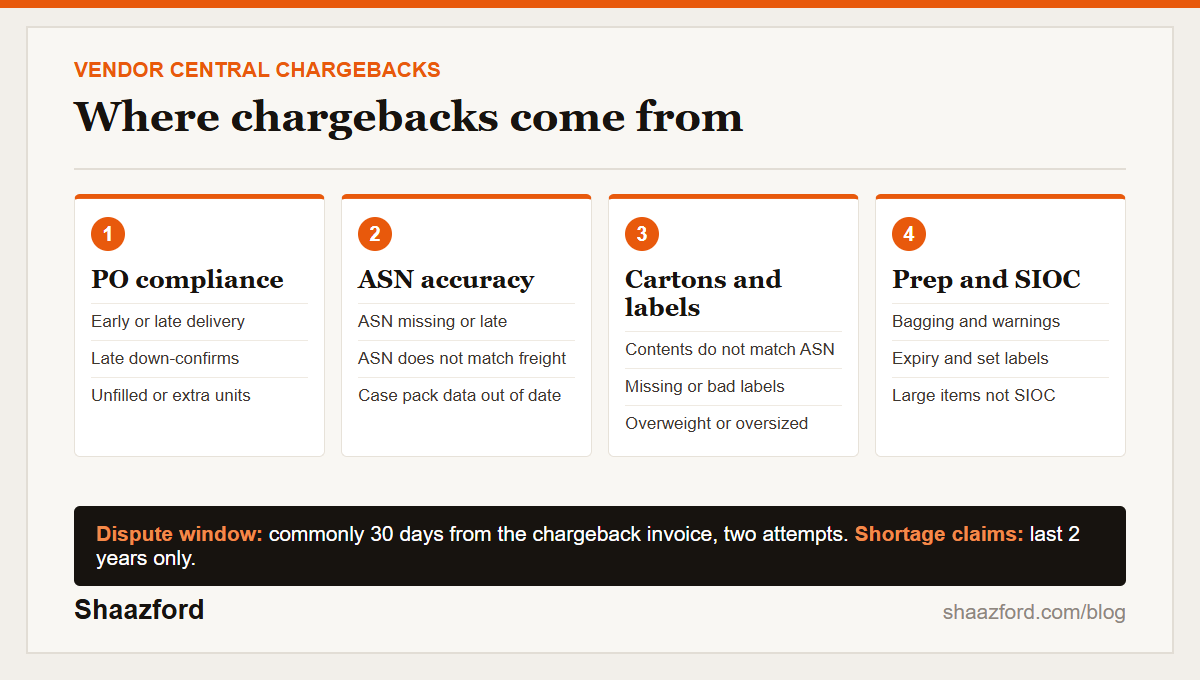
- The biggest families: purchase order compliance, ASN accuracy, carton content and labeling, and prep.
- The commonly reported dispute window is 30 days from the chargeback invoice date, with two attempts. Miss it and the money is gone.
- Shortage claims (PQV) can only be disputed on invoices from the last two years, and bulk claims have ended.
- A weekly chargeback review, with one root cause fixed each week, cuts more cost than any dispute service.
What is a Vendor Central chargeback?
As a first-party (1P) vendor, you sell to Amazon on purchase orders and ship cases into its fulfillment network. Amazon's warehouses are built around predictable, standardized inbound freight. When your shipment makes that harder, by arriving late, carrying the wrong quantity, missing its electronic paperwork or arriving in the wrong packaging, Amazon charges you for the extra handling. That charge is a chargeback, and it is deducted from what Amazon owes you.
Chargebacks are only one of several deductions on a vendor account, and mixing them up is the first reason disputes fail:
| Deduction | What it is | How you fight it |
|---|---|---|
| Chargebacks | Penalties for operational non-compliance (timing, quantities, ASN, cartons, labels, prep) | Dispute each chargeback with evidence, within the dispute window |
| Shortage claims (PQV) | Amazon says it received fewer units than you invoiced | Dispute with proof of delivery and counts, invoice by invoice |
| Price claims (PPV) | The invoiced price does not match the PO cost | Dispute with the agreed cost and the PO record |
| Co-op and allowances | Negotiated percentages for marketing, freight and damages | Negotiate in your annual terms; audit that invoices match the agreement |
If you are still deciding whether the 1P model is worth these costs at all, our Amazon 1P vs 3P comparison runs the full margin math.
Why do chargebacks matter more than they look?
Each chargeback looks small: 3% of the cost of one late purchase order, a few dollars on a mislabeled carton. But they repeat on every shipment until the root cause is fixed. Audits of large volumes of Vendor Central revenue put chargebacks at roughly 1% to 5% of invoice value a year, with a spike in the fourth quarter, when volumes peak and delivery windows are hardest to hit.
For a brand invoicing Amazon $5 million a year, that is $50,000 to $250,000 a year leaving the business quietly, before co-op and shortage claims. On wholesale margins, it can be the difference between a profitable vendor account and an unprofitable one.
Every major chargeback type, and what it costs
Amazon publishes its current chargeback types and rates in Vendor Central, and it changes them, sometimes without much notice. The rates below are commonly reported figures for the US, collected from vendor operations specialists. Always check your own Vendor Central chargeback page before you build a budget around them.
| Chargeback | What triggers it | Commonly reported cost |
|---|---|---|
| PO on-time accuracy | Units arrive before or after the PO delivery window | About 3% of product cost |
| Down-confirmed units | You reduce confirmed quantities late, after the confirmation window | About 3% of product cost |
| Unfilled units | You confirm units and never ship them | Reported at 5% to 10% of product cost |
| Overage and unconfirmed units | You ship more units than confirmed, or units never confirmed | About 10% of product cost, rising steeply for large overages |
| ASN accuracy | The ASN is missing, late, or does not match what arrives | About 1% to 6% of product cost, by type and compliance rate |
| Carton content accuracy | What is in a carton does not match the ASN | Per unit, and every unit in a mismatched carton can count as defective |
| Carton labeling | Missing, unreadable or wrong carton or shipping labels | Flat fee per carton |
| Overweight or oversized cartons | Cartons over Amazon's weight or size limits | Flat fee per carton |
| Prep | Units not bagged, wrapped, labeled or protected to category rules | Flat fee per unit |
| SIOC | Large items not certified to Ship In Own Container | Flat fee per unit |
Purchase order compliance
This is usually the biggest family. Amazon plans labor and dock space around the quantities and delivery windows you confirm. Arriving early is penalized just like arriving late, because Amazon has not planned to receive you. Confirming units you cannot ship, then cancelling or under-filling, is penalized more heavily than declining them up front. The lesson: confirm only what you can deliver, on time, and decline or down-confirm early rather than late.
Amazon has historically waived the on-time chargeback for vendors whose trailing four-week on-time rate stayed above a threshold (90% has been the commonly cited figure, and some vendors report a higher bar in 2026). Check the threshold on your own dashboard, because staying above it is one of the cheapest wins available.
ASN accuracy
The ASN is the electronic message (EDI 856 for most vendors) that tells Amazon what is arriving, in which cartons, before the truck pulls in. A missing ASN, one sent after the shipment arrives, or one that does not match the physical freight all trigger chargebacks, and they often cascade into carton content chargebacks as well. Most ASN problems are system problems: an EDI integration that sends too late, a warehouse system that does not update after a last-minute repack, or a case pack that changed without the item data changing.
Carton content and labeling
Every carton needs a correct, scannable label, and its contents must match the ASN exactly. Mixed cartons, wrong case-pack quantities and handwritten or damaged labels all cost money. Carton content chargebacks are among the most expensive per incident, because a mismatched carton can be counted defective unit by unit.
Prep, packaging and SIOC
Some categories need poly bags with suffocation warnings, bubble wrap, expiration date labeling or sets bundled as one unit. Large items must be certified to ship in their own container. If Amazon has to prep, repack or relabel a product, it charges for it. Check the prep requirements for every new ASN before its first purchase order, not after the first chargeback.
Where do I find my Vendor Central chargebacks?
Chargebacks show up in Vendor Central in two places that matter:
- The Operational Performance dashboard shows chargebacks by type and week, and lets you drill into the specific POs and ASINs behind each one. This is where root-cause work starts.
- Your invoices and payments show the chargeback invoices themselves, which are what you dispute and what reduces your payment.
Export both every week. Most vendors who lose money to chargebacks are not unaware of them. They simply never look at them in one place.
How do I dispute a Vendor Central chargeback?
Disputes are worth filing when Amazon is wrong, and Amazon is wrong more often than vendors assume. The commonly reported rules are a 30-day window from the chargeback invoice date and two attempts per chargeback, so speed and evidence matter more than anything.
- Pull the chargeback detail. Identify the PO, ASIN, shipment and the exact defect Amazon recorded.
- Check it against your records first. If the defect is real, do not dispute it. Fix the cause. Disputing valid chargebacks wastes your two attempts and your credibility.
- Gather evidence. Proof of delivery and appointment confirmation for timing disputes, EDI transmission records and acknowledgments for ASN disputes, packing lists and carton photos for content disputes, label images for labeling disputes, and PO confirmation records for quantity disputes.
- File in Dispute Management within the window, one chargeback at a time, with a short, factual explanation that points to the evidence.
- Track the outcome. If the first dispute is denied and you still have a strong case, use your second attempt with any additional evidence. Log every result so you can see which disputes win.
The best evidence is collected at the time of shipping, not reconstructed a month later. That is why carton photos, label scans and appointment records should be routine in your warehouse, not a special effort.
Shortage claims: the deduction that is not a chargeback
A shortage claim (purchase quantity variance, or PQV) means Amazon says it received fewer units than you invoiced, so it pays you less. For many vendors shortages cost more than chargebacks. They follow different rules:
- Two-year limit. Disputes on invoices more than two years old are now rejected automatically. This began in North America and has been spreading to other regions.
- No more bulk claims. Vendors used to bundle thousands of line items into one case. Claims now go through Dispute Management item by item.
- Re-disputes and settlements generally go through an Amazon vendor manager, if your account has one.
- Evidence is proof of delivery with counts: signed bills of lading, carrier delivery records and carton-level shipping data.
Price claims (PPV) work the same way: they arise when your invoiced cost does not match the cost on the PO, and the fix is keeping your cost data in sync with your agreed terms.
How to prevent chargebacks: a ten-point routine
- Confirm POs honestly. Confirm only what you can ship in the window. Decline or down-confirm early.
- Book delivery appointments early and plan carrier pickup with buffer for peak weeks.
- Send the ASN before the freight arrives, generated from what was actually packed, not from the PO.
- Standardize case packs and keep item data in Vendor Central identical to what the warehouse ships.
- Label every carton to Amazon's standard, printed, scannable and placed correctly.
- Check weight and size limits at packing, before the carton leaves.
- Look up prep rules for every new ASIN before its first purchase order.
- Certify large items for SIOC where it applies.
- Review chargebacks every week by type, ASIN and warehouse, and fix the single biggest cause each week.
- Plan the fourth quarter in September, when there is still time to add capacity and carrier cover.
Disputes recover money you have already lost. Prevention stops you losing it. The vendors with the lowest deductions treat the weekly chargeback report as an operations scorecard, not a finance problem.
When chargebacks mean it is time to rethink 1P
Add your chargebacks, shortage claims and co-op together and divide by what Amazon paid you. If that total keeps climbing while Amazon also pushes your cost price down, the vendor account may no longer be the better model. Compare it honestly against what the same products would net as a third-party seller. If 3P wins, our Vendor Central to Seller Central migration playbook shows how to move without losing rank. Many brands land on a hybrid: keeping simple, high-volume products on 1P and moving the rest to 3P.
How Shaazford handles chargebacks
Our Vendor Central management covers the whole deduction cycle for brands doing $100K or more a month: a weekly chargeback and shortage review, root-cause fixes with your warehouse or 3PL, disputes filed inside the window with the right evidence, purchase order confirmation discipline, and the catalog and ASN data behind it all.
Pricing is flat: $1,600 a month for full account management. Many recovery services take a percentage of what they recover. We do not take a percentage of anything, recoveries or ad spend. We treat your vendor account as if it were our own business, which means caring as much about the chargebacks that never happen as the ones we win back.