
Amazon 1P vs 3P is the same choice as Vendor Central vs Seller Central, and the difference is who you sell to. On Seller Central (third party, or 3P) you sell directly to Amazon shoppers: you set the price, you own the listing and the data, you pay Amazon a referral fee (8% to 15% in most categories) plus $39.99 a month, and you are paid on a rolling cycle. On Vendor Central (first party, or 1P) you sell wholesale to Amazon on purchase orders: Amazon sets the retail price, the listing says "Ships from and sold by Amazon", you are paid on net terms (commonly 60 to 90 days), and Amazon deducts co-op allowances and chargebacks. Seller Central is open to anyone. Vendor Central is invitation-only. For most brands doing $100K or more a month, Seller Central, or a deliberate hybrid, keeps more margin and more control.
Key takeaways
- 1P (first party) runs through Vendor Central. 3P (third party) runs through Seller Central.
- Seller Central makes you the retailer. Vendor Central makes you Amazon's wholesale supplier.
- On Seller Central you control price, stock and customer data. On Vendor Central, Amazon controls the retail price and the buying decision.
- Seller Central pays every couple of weeks after a delivery hold. Vendor Central pays on net terms, commonly 60 to 90 days, minus deductions.
- Vendor Central is invitation-only, and Amazon has cut smaller vendors twice, in 2019 and again in late 2024.
- A hybrid (some ASINs 1P, some 3P) can work, but only with clear rules for which products sit where.
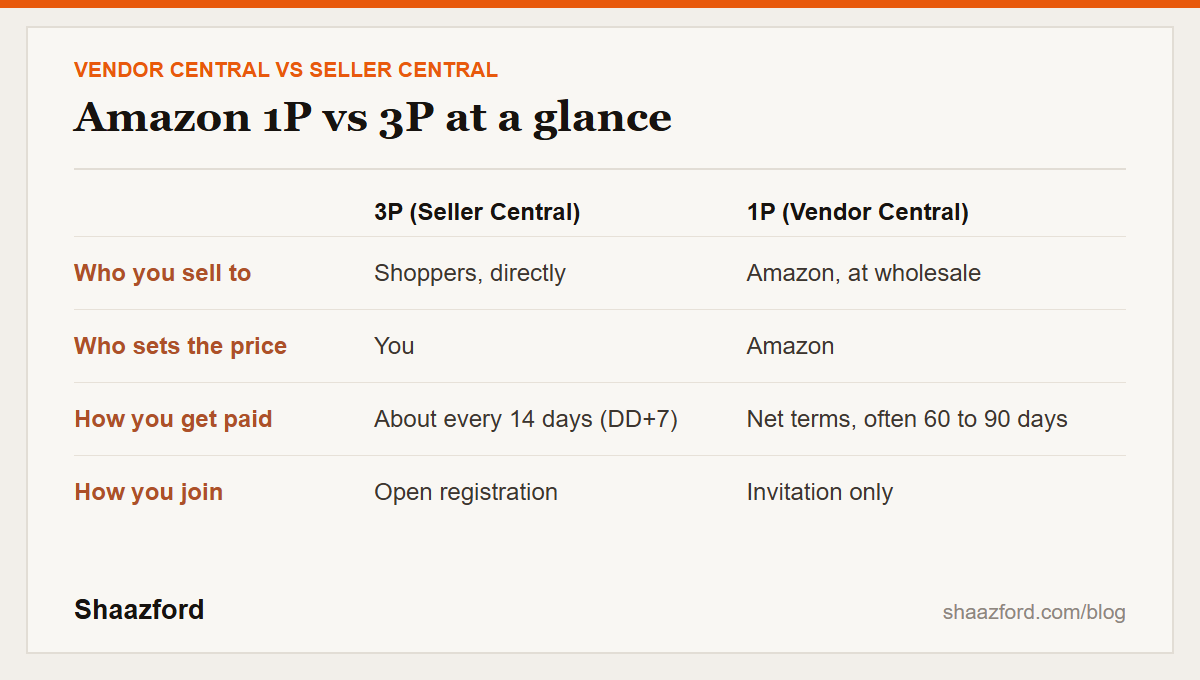
Amazon 1P vs 3P: what the terms mean
Amazon's business has two sides, and the industry names them by who is doing the selling.
- 1P, or first party: Amazon is the seller. It buys your products at wholesale and sells them to shoppers as its own retail inventory. Brands do this through Vendor Central, and they are called vendors.
- 3P, or third party: you are the seller. Amazon provides the marketplace, the traffic and optional services such as FBA, and you sell directly to shoppers. Brands do this through Seller Central, and they are called sellers.
So "1P vs 3P", "first party vs third party" and "Vendor Central vs Seller Central" all describe the same decision. Third-party sellers now account for the majority of units sold in Amazon's store, which is why most of the tools, programs and advertising options Amazon launches reach Seller Central first. The rest of this guide uses the portal names, because those are the accounts you actually log in to.
What is Amazon Seller Central (3P)?
Seller Central is the portal for third-party sellers, the businesses that sell their own inventory on Amazon's marketplace. Roughly speaking, Amazon acts as the shopping mall and you rent the shelf. The buyer pays Amazon, Amazon keeps its fees, and the rest is paid out to you.
Anyone can register. You pick a selling plan (Individual at $0.99 per item sold, or Professional at $39.99 a month), verify your identity and business, and list products. Once your brand has a registered or pending trademark you can enroll in Amazon Brand Registry, which unlocks A+ Content, Brand Stores, Sponsored Brands ads, Brand Analytics and stronger protection against hijackers.
What you control on Seller Central:
- Price. You set it, change it daily if you want, and decide when to run a coupon or a deal.
- Inventory. You decide how much to send, when, and whether Amazon ships it (FBA) or you do (FBM, or Seller Fulfilled Prime).
- Listings. As brand owner you control titles, bullets, images and A+ Content.
- Data. Sales by ASIN, traffic, conversion, search terms and ad data, in near real time.
- Advertising. Sponsored Products, Sponsored Brands and Sponsored Display, managed directly or by an Amazon PPC team.
What it costs: the monthly plan fee, a referral fee on every sale (8% to 15% in most categories, with a few categories higher), FBA fulfillment and storage fees if you use FBA, and your advertising. Our full breakdown of Amazon selling costs walks through each line.
What is Amazon Vendor Central (1P)?
Vendor Central is the portal for first-party suppliers, the brands and manufacturers that sell their products to Amazon itself. Here Amazon is not the mall. Amazon is the store. It issues you a purchase order, you ship cases to its fulfillment centers, it pays your invoice on agreed terms, and then Amazon resells your product to shoppers as its own retail inventory.
You cannot sign up for it. Vendor Central is invitation-only: Amazon's retail teams invite brands they want to buy from, usually brands with proven demand, strong retail distribution or products Amazon wants to stock. Our guide on how to apply for Vendor Central covers what actually gets a brand invited.
What Vendor Central gives you:
- "Ships from and sold by Amazon". Some shoppers trust that line more than a third-party seller name.
- Large, predictable orders. You sell by the case on purchase orders, not by the unit.
- Less retail work. Amazon handles customer service, returns and last-mile shipping on the units it owns.
- Vendor marketing programs. Vendor-funded promotions, Amazon Vine, A+ Content and access to Amazon DSP and Amazon Ads.
What it costs: there is no monthly fee, but the cost sits inside the terms. Amazon negotiates your wholesale cost price, then takes co-op allowances (marketing, freight and damage allowances, usually a percentage of what it buys), and charges chargebacks when your shipments break its rules on labels, cartons, timing or quantities. Industry estimates put co-op at around 8% to 10% or more of purchases and operational chargebacks at 1% to 5% of invoice value, depending on how clean your operations are.
Amazon 1P vs 3P side by side: Vendor Central vs Seller Central
This is the comparison most brands need before anything else.
| Seller Central (3P) | Vendor Central (1P) | |
|---|---|---|
| Who you sell to | Amazon shoppers, directly | Amazon, at wholesale |
| How you join | Open registration | Invitation only |
| Who sets the retail price | You | Amazon |
| Listing shows | Your seller name | "Ships from and sold by Amazon" |
| How you get paid | Sales minus fees, paid out on a rolling cycle | Invoices on purchase orders, net terms |
| Typical payment timing | About every 14 days, after a hold of 7 days past delivery (DD+7) | Commonly 60 to 90 days after invoice |
| Main costs | $39.99 a month, referral fees, FBA fees, ads | Lower cost price, co-op allowances, chargebacks, ads |
| Fulfillment | FBA, FBM or Seller Fulfilled Prime | You ship cases to Amazon; Amazon ships to shoppers |
| Customer and sales data | Detailed and near real time | Retail analytics, focused on Amazon's sales of your product |
| Inventory decisions | Yours | Amazon's purchase orders |
| Advertising | Sponsored ads, DSP | Sponsored ads, DSP, vendor-funded promotions |
| Main risk | Fees, stockouts, account health | Margin erosion, slow cash, losing the account |
| Best fit | Most brands, from launch to $1M+ a month | Large brands with retail-ready supply chains |
Notice the pattern. Seller Central trades more work for more control. Vendor Central trades control for scale and simplicity, and it hands Amazon the one lever that matters most to your margin: the price.
How the money works: one $100K month on each model
Abstract pros and cons hide the real question, which is how much of each sale reaches your bank account and when. Here is an illustrative example: a product that retails at $30, selling about 3,333 units a month, roughly $100K in retail sales. Your categories, fees and terms will differ, so treat these as a way to model, not as quotes.
| Line | Seller Central (3P) | Vendor Central (1P) |
|---|---|---|
| Revenue to you | $100,000 (retail sales) | $55,000 (Amazon buys at $16.50 a unit) |
| Referral fee (15%) | -$15,000 | n/a |
| FBA fulfillment (about $5.00 a unit) | -$16,665 | n/a (Amazon ships its own stock) |
| Storage and other FBA fees | -$2,000 | n/a |
| Plan fee | -$40 | n/a |
| Co-op allowances (10%) | n/a | -$5,500 |
| Chargebacks and shortages (3%) | n/a | -$1,650 |
| Freight to Amazon | Included in your inbound costs | -$1,500 |
| Before product cost and ads | About $66,300 | About $46,350 |
| When the cash arrives | Within weeks of each sale | Two to three months after each invoice |
In this example Seller Central leaves about $20,000 more a month before product cost and advertising, and it pays you far sooner. Vendor Central's case is everything that is not in the table: Amazon carries the retail risk, buys in volume, and handles customer service and returns on its units.
Two things the table cannot show. First, on Vendor Central Amazon can drop the retail price to match a competitor, and its systems then push back on your cost price to recover margin. Second, on Seller Central the full $100,000 is exposed to your own mistakes: a stockout, an account health issue or a weak ad account costs you directly. Which risk is worse depends on the strength of your operations.
The question is never "which portal is better". It is "after every deduction, which model leaves more cash, sooner, for this product?"
Seller Central: pros and cons
Pros
- Price control. You protect your price and your brand position, and you can run promotions when it suits you.
- Better margins for most brands. You keep the retail margin instead of selling it to Amazon at wholesale.
- Faster cash. Even with the DD+7 hold, payouts arrive in weeks, not months.
- Full data. Conversion, sessions, search terms and ad data at ASIN level, so you can make decisions quickly.
- Open access. Nobody has to invite you, and nobody can end the relationship with one email, as long as account health stays good.
Cons
- More work. Inventory planning, FBA shipments, account health, pricing and customer messages are all yours.
- Fees add up. Referral, fulfillment, storage and low-inventory fees need constant watching. Amazon changes them every year.
- Account health risk. Policy issues, IP complaints or late shipments can suspend listings. An account health routine is not optional.
- Competition on your own listing. Without Brand Registry and monitoring, resellers and hijackers can attach to your ASINs.
Vendor Central: pros and cons
Pros
- Volume. Purchase orders can be large, and selling by the case is operationally simple.
- Shopper trust. "Sold by Amazon" can lift conversion in categories where buyers are wary of third-party sellers.
- Less customer-facing work. Amazon owns customer service and returns on its inventory.
- Programs and support. Vendor-funded deals, Vine and premium content tools, plus a vendor manager for larger accounts.
Cons
- No price control. Amazon sets the retail price. If it matches a low price elsewhere, your other retailers notice.
- Margin erosion. Co-op, freight allowances, chargebacks and annual negotiations steadily move margin toward Amazon.
- Slow cash. Net terms of 60 to 90 days, with deductions taken before payment.
- Unpredictable orders. Purchase orders can shrink or stop with little warning, and you cannot sell more than Amazon buys.
- The account can end. Amazon stopped buying from thousands of smaller vendors in 2019 and sent termination notices to many vendors in November 2024, most of them reportedly under $5 to $10 million a year in vendor sales.
Can you switch between Vendor Central and Seller Central?
Seller Central to Vendor Central: only by invitation. You cannot move yourself across. If an invitation arrives, model the margin first: compare Amazon's proposed cost price, minus co-op and expected chargebacks, against what your Seller Central account nets today.
Vendor Central to Seller Central: anyone can do it, whether by choice or because Amazon ended the relationship. The listings already exist, so you are adding your own offer to ASINs that have reviews and history. A clean transition usually looks like this:
- Open and verify a Seller Central account early. Verification can take weeks.
- Connect Brand Registry so you control the listing content and can use A+ Content, Brand Stores and Sponsored Brands as a seller.
- Plan the overlap. Amazon may keep selling the units it already bought, often at its own price. Expect a period where its offer and yours sit on the same listing.
- Send inventory to FBA (or set up FBM) so your offer can win the featured offer once Amazon's stock runs down.
- Rebuild advertising in the seller ad account. Vendor ad history does not move across.
- Set pricing rules that protect margin and stay consistent with your other channels.
Our Vendor Central to Seller Central migration playbook walks through each of these steps in detail, with a 90-day plan. Brands that plan the switch usually lose very little momentum. Brands that wait for the last purchase order and then scramble often lose rank for a few weeks.
The hybrid model: running 1P and 3P together
Many larger brands run both accounts, selling some products to Amazon through Vendor Central and others directly through Seller Central. Done well, it combines Amazon's buying power on high-volume staples with your control over new launches, bundles and higher-margin items.
Done badly, it means two offers on one listing, Amazon undercutting your own price, and nobody sure who is responsible for each ASIN. The rules that make a hybrid work:
- Split by ASIN, not by mood. Each product has one owner, 1P or 3P, written down.
- Keep fast, simple sellers on 1P. High-volume, easy-to-ship products suit purchase orders.
- Keep launches, bundles and heavy or fragile items on 3P, where you control price and presentation.
- Watch for price conflicts. If Amazon's retail price drops on a 1P item, check how it affects your 3P items and your other retailers.
- Review the split quarterly using net margin per ASIN after every deduction, not top-line sales.
1P or 3P: which should you choose?
| Your situation | Our recommendation |
|---|---|
| Launching, or under $100K a month on Amazon | Seller Central with Brand Registry. Build demand and data first. |
| $100K to $1M a month, growing | Seller Central, run tightly. Consider a hybrid only if a vendor offer beats your 3P net margin. |
| Large brand, strong retail distribution, retail-ready logistics | Vendor Central or a hybrid can make sense, with a deduction-recovery routine in place. |
| You just received a vendor invitation | Model the margin line by line before you accept. Do not accept for the badge alone. |
| Amazon ended your vendor account | Move to Seller Central now, while your listings, reviews and rank are intact. |
The pattern is consistent. Vendor Central rewards brands whose operations are already built like a major supplier's. Seller Central rewards brands that want to keep their margin and are willing to run the account properly. For the brands we work with, doing $100K or more a month and aiming for $1M, that usually means Seller Central first, with Vendor Central treated as an option to evaluate, not a promotion.
How Shaazford runs both
We run Seller Central and Vendor Central accounts for brands doing $100K or more a month. On the seller side: listings, advertising, inventory planning and account health. On the vendor side: purchase orders, chargeback and shortage disputes, scorecards, catalog and vendor advertising. If you are deciding between them, or running a hybrid that is not working, we start with the margin model above using your real numbers.
Pricing is flat: $1,600 a month for full account management on either model, with no percentage of ad spend and no contract, plus a $500-a-month Essentials plan for brands that only need a specialist a couple of hours a day. And we treat your business as if it were our own. You can see how that works on a real account in our Importer AM case study.